The use of spectral data to predict soil organic matter in European
soils
Soil
organic matter
Soil organic
matter (SOM) is the fraction of the soil that consists of plant and animal
detritus (remains, waste products and other organic debris) at various stages
of decomposition (breakdown), cells and tissues of soil microbes, and
substances that soil microbes synthesize. It is estimated that concentration of
SOM in most of the productive agricultural soils ranges between 3 % and 6 %.
Even though it is only a small part of soil organic matter contributes to soil
productivity in numerous ways and the various components of organic matter
influence different properties of soil.
From the
chemical point of view SOM is composed mainly of just a few chemical elements
namely carbon, hydrogen and oxygen. These elements together make almost 92 % of
all SOM. However, organic matter also contains small amounts of other essential
elements, such as nitrogen, phosphorus, sulfur, potassium, calcium and
magnesium which are encompassed in organic residues.\A0
Generally,
SOM is divided into living and dead components which can range from
very recent inputs, such as stubble, to largely decayed materials that are
thousands of years old. It is estimated that about 10 % of below-ground SOM,
such as roots, fauna and microorganisms, fall into the living category (see Fig. 1).
It is
normally considered that SOM is made up of different components which
vary widely in size, turnover time and composition in the soil. These
components can be grouped into four major types:
1. Dissolved
organic matter;
2.
Particulate organic matter;
3. Humus;
4. Resistant
organic matter.
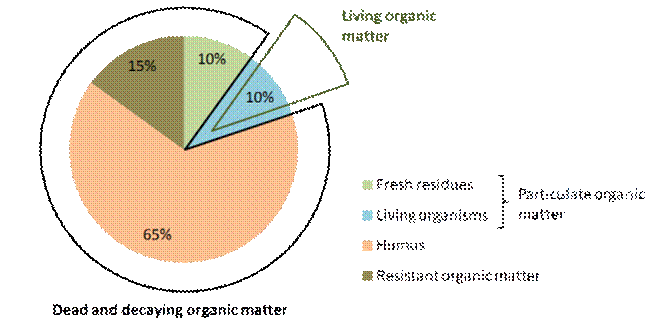
Fig. 1.
Composition of soil organic matter.
The living organic matter
includes such parts as the microorganisms responsible for decomposition
(breakdown) of both plant residues and active soil organic matter or detritus. Organic compounds in vegetal detritus includes
carbohydrates which range in complexity from simple sugars to the complex
molecules of cellulose, fats that are composed of glycerides of fatty acids,
like butyric, stearic, and oleic, lignins that are complex
compounds, formed from the older parts of wood, and are resistant to
decomposition, proteins, and charcoal. Humus is the stable fraction of
the soil organic matter that is formed from decomposed plant and animal tissue
and is the final product of the decomposition processes. The first two types of
organic matter (dissolved organic matter, particulate
organic matter) contribute to soil fertility because the breakdown of
these fractions results in the release of plant nutrients such as nitrogen,
phosphorus, potassium, etc. The humus fraction has less influence on soil
fertility because it is the final product of decomposition. Therefore, humus is
also called the stable organic matter.
However, it still has much importance to soil fertility because it contributes
to soil structure, soil tilth, and cation exchange capacity. This is also the
fraction that darkens the soil\92s color.
There are many benefits of soil
organic matter in an agricultural soil. These
benefits can be grouped into three categories:
Physical
Benefits
●
Enhances aggregate stability, improving water infiltration and
soil aeration, reducing runoff.
●
Improves water holding capacity.
●
Reduces the stickiness of clay soils making them easier to till.
●
Reduces surface crusting, facilitating seedbed preparation.
Chemical
Benefits
●
Increases the soil\92s cation-exchange capacity or its ability to
hold onto and supply over time essential nutrients such as calcium, magnesium
and potassium.
●
Improves the ability of a soil to resist pH change (also known as
buffering capacity).
●
Accelerates decomposition of soil minerals over time, making the
nutrients in the minerals available for plant uptake.
Biological
Benefits
●
Provides food for the living organisms in the soil.
●
Enhances soil microbial biodiversity and activity which can help
in the suppression of diseases and pests.
●
Enhances pore space through the actions of soil microorganisms.
This helps by increasing infiltration and reducing runoff.
Evaluation of soil organic matter concentration
Due to the
forementioned benefits of soil organic matter it is regarded as one of the key
parameters (characteristics) of soil and is measured routinely to monitor the
soils health and condition. Due to the complexity of the composition of soil
organic matter it is difficult to directly evaluate its amount. This is why
most often the concentration of SOM in soil is determined first by determining
the total carbon content - soil organic carbon (SOC). Then SOM is evaluated
from the calculated value of SOC. The calculation between the concentrations of
SOC to SOM has historically formed to be a simple act of multiplication by a
constant  \A0(van Bemmelen factor):

The value of
the constant  \A0is derived from the assumption that soil
organic matter is comprised of 58 % of carbon. However,
throughout the years the legitimacy of this value was put under question.
Several studies have shown that the conventional carbon-to-organic matter
conversion factor is too low for universal application and fails to account for
the significant variation in the carbon content of soil organic matter.
Therefore, there have been many suggestions on what value of the constant should
be used for soils regarding their composition (see Table 1).
\A0is derived from the assumption that soil
organic matter is comprised of 58 % of carbon. However,
throughout the years the legitimacy of this value was put under question.
Several studies have shown that the conventional carbon-to-organic matter
conversion factor is too low for universal application and fails to account for
the significant variation in the carbon content of soil organic matter.
Therefore, there have been many suggestions on what value of the constant should
be used for soils regarding their composition (see Table 1).
Table 1. The evaluated values of conversion
factor in different countries and soils (D. W. Pribly,
2010).
|
Country |
Soil description |
Factor value |
Reference |
||
|
Low |
Average |
High |
|||
|
Belgium |
Soils (rich in organic matter) |
1.44 |
2.05 |
3.10 |
De Leenheer et al. (1957) |
|
Denmark |
Forest |
1.55 |
2.63 |
15.4 |
Christensen and Malmros (1982) |
|
England |
Mineral; agricultural |
2.52 |
3.45 |
14.1 |
Warrington and Peake (1880) |
|
England |
Forest; Wetlands |
1.78 |
2.07 |
3.62 |
Howard (1964) |
|
Europe |
Forest; grass; peat |
1.97 |
2 |
2.5 |
Ponomareva and Plotnikova (1967) |
|
US |
Mineral |
1.63 |
1.92 |
2.14 |
Alexander and Byers (1932) |
|
Wales |
Peat |
1.86 |
1.88 |
1.95 |
Robinson et at. (1929) |
|
Wales |
Mineral and organic |
1.74 |
2.73 |
5.64 |
Ball (1964) |
|
Worldwide |
Mineral and organic |
1.35 |
1.74 |
2.44 |
Robinson (1927) |
|
Worldwide |
Surface soils |
1.9 |
2.2 |
2.5 |
Broadbent (1953) |
Various
experimental and theoretical studies were performed in order to evaluate the
optimal value of the conversion factor and one of the most suggested value is  \A0(Douglas W. Pribly, 2010).
The standard
practice for determining
organic carbon is performing chemical analysis of the
soil. This method involves a lot of procedural tasks and chemical reagents but
provides an accurate value of the SOC. However, the time and economic resources
needed for such analysis are not favorable because the evaluation of SOM cannot
be efficiently upscaled for larger fields or continuous monitoring. Such
drawbacks of the standard SOC analysis techniques led to the emergence of other
SOM evaluation techniques. One of them \96 hyperspectral or multispectral
spectroscopy, has gained a lot of traction in the past decade and is becoming
more and more applied for determination of all sorts of soil parameters
(citation).
Hyperspectral and multispectral imaging
Hyperspectral
imaging (HSI) spectroscopy is a modern and informative method belonging to the
larger group of spectroscopy and spectral photography methods. Hyperspectral
imaging technology is based on detection of the electromagnetic radiation
reflected (most often) from the analyzed object (sunlight is usually used as
the source of radiation) and collected in a vast range of spectral bands. The
reflected light is detected using passive type scanning or snapshot sensors.
Hyperspectral imaging spectroscopy is a remote sensing method which differs from other non-destructive remote spectroscopy methods
in that during the scanning or instantaneous capture
procedures a three-dimensional data array (so called hyperspectral cube) is
generated. Hyperspectral cube can essentially be described as a
three-dimensional data format where two dimensions (let\92s say x-axis and y-axis) describe the
spatial coordinates and the third dimension (z-axis) describe the spectral coordinates (wavelength). One
hyperspectral image can have tens or hundreds of spectral bands and each pixel
of the image presents the reflected and sensor-recorded electromagnetic
radiation intensity. Depending on the design and technical parameters,
hyperspectral sensors can record information starting with ultraviolet light
part of the spectrum (wavelength from around 200 nm) and ending in the
long-wave infrared light (wavelength up to 15 μm).
Hyperspectral imaging technology due to its informativeness and ease of
application is used in many different fields: medicine, food industry, material
property research, natural resource exploration, land on the farm, etc. Such
a wide range of applications is provided by the
physical nature of the method, which can be briefly described as the
fundamental interaction of the electromagnetic radiation and matter (in terms
of molecular structures). Because of this, hyperspectral imaging spectroscopy
can be applied to
study the spectral properties of light reflected by objects under study in
order to identify the molecular compounds, determine their chemical and
physical properties.
Close to
hyperspectral, but simpler, and at the same time more primitive and less
informative, technology is multispectral photography. In the latter, spectral
images are generated by collecting the radiation data in much wider (several
tens of nanometers and more) spectral bands. In contrast to hyperspectral
sensors, multispectral sensors do not cover the full spectral range of the
camera operation range. A fairly simple comparison of the hyperspectral and
multispectral imaging results is presented in Fig. 2.

Fig.
2. Comparison of the data collected using multispectral (left) and
hyperspectral (right) imaging methods.
In regard to the quality
of the hyperspectral images, three main resolution parameters which determine
the level of gathered information can be described. These are:
●
Spatial resolution;
●
Spectral resolution;
●
Temporal resolution.
Spatial
resolution is described as the smallest discernible detail in an image. It can
be regarded as the dimension of the smallest object in an image that can be
distinguished as an individual part. Spatial
resolution is directly related to the clarity of the image. However, it should
be mentioned that spatial resolution should
not be mixed up with the number of pixels in
an image. The spatial characteristics of a hyperspectral image depend on the
design of the imaging sensor in terms of its field of view and the altitude at
which the image is captured. If we consider that a finite patch of the ground
is captured by each detector in a remote imaging sensor then the spatial
resolution is inversely proportional to the patch size. Therefore, the smaller
the size of the patch, the higher details can be interpreted from the observed
scene.
Spectral
resolution is defined as the number of spectral bands in the whole range of
electromagnetic spectrum captured by the sensor. For example, the sensor might
collect the light in a large frequency range but still have a low spectral
resolution if the information is gathered from a small number of spectral
bands. On the contrary, if a sensor collects the data from a small frequency
range but captures a large number of spectral bands, high spectral resolution
is obtained. In such cases it is possible to distinguish between two similar elements
(having similar spectral features). Multispectral images, therefore, have a low
spectral resolution and using this method it is not possible to resolve finer
spectral signatures present in the analyzed area. HSI sensors acquire images in
numerous continuous and extremely narrow spectral bands in mid infrared, near
infrared and visible parts of the electromagnetic spectrum. This type of advanced imaging system shows tremendous potential for material
identification on the basis of their unique spectral signatures. Spectrum of a
single pixel in a hyperspectral image can give considerably more information
about the surface of the material than a normal image. It is worth mentioning
that even though multispectral imaging does not have as high spectral
resolution as hyperspectral imaging, oftentimes
it is much more practical to use. For example, in some cases it can be known
for certain in which specific parts of the electromagnetic spectrum largest variations or differences between the
spectral information of the analyzed objects are present. Therefore, collecting
the information in the whole spectral range does not provide any more useful
information and only burdens the analysis by adding redundant information.
Temporal
resolution is considered if routine measurements of hyperspectral or
multispectral remote sensing are made. In such cases depending on the type of information acquisition method
the temporal resolution can depend on the orbital characteristics of the
imaging sensor or the period of the experimental tests. Generally, the temporal
resolution can be defined as the time needed to revisit and obtain data from
the exact same location. Therefore, temporal resolution is considered high if
the period between two measurements of the exact same location is short and is
considered low if the said period is long. In general practice this parameter
is defined in days.
Collection of the spectral data
Remote sensing applications
provide unprecedented data streams for the retrieval and hence allow the
monitoring of SOC across the VNIR\96SWIR spectral range. The different sensors
used to collect the spectral data are generally mounted on either airborne or
spaceborne platforms. Also, unmanned aerial vehicle (UAV) systems have become
available to carry out the fully autonomous hyperspectral analysis. All
available remote sensing platforms can be differentiated in terms of their
spatial, spectral, and temporal resolution that consecutively specifies their
accuracy and the field of application. To put it in brief, different sensing
applications can be applied using three systems: satellite, airborne, and
unmanned aerial vehicle systems.
Satellite remotely sensed
imagery has a lot of potential to generate spatial maps of the upper soil
horizon. Satellite multispectral sensing was first used in quantitative SOC
characterization as soon as the first satellites were launched in the 1980s.
The hyperspectral data became increasingly popular several years later when the
Hyperion spaceborne system became operationally available. Nowadays, there are
few studies using satellite sensors for SOC estimation. Due to the increased
satellite data availability the SOC estimation and mapping based on spaceborne
data is starting to be increasingly developed. This was enabled by various
factors like distribution of the Landsat at no charge, free and open access
Sentinel-2 super spectral imagery data, as well as by the emergence of large
fleets of small satellites like Planet Cubesats. The
future prospects are also bright since a lot of hyperspectral imaging
satellites are planned to be put into orbit. The forthcoming projects are the
German Environmental Mapping and Analysis Program (EnMAP),
Italian PRecursore IperSpettrale
della Missione Applicativa (PRISMA), the U.S. NASA Hyperspectral Infrared
Imager (HyspIRI), the Japanese Hyperspectral Imager
Suite (HISUI), the Israeli Hyperspectral imager (SHALOM), and the China
Commercial
Remote-sensing Satellite
System (CCRSS).
Airborne hyperspectral
imaging has its benefits by offering the ability for the spatial assessment of
soil conditions with higher accuracy. Even though the imaging field is not as
large as with satellite data, the produced information can cover large areas
even from a single flight mission. The use of aircrafts can also provide the
data for segmentation of the investigated site in accordance to its soil
heterogeneity. Aircrafts have high capacity and can carry great payloads what
gives the ability for wide spectral range hyperspectral sensors to be mounted
on them and interchanged between flights. In addition to that, airborne mounted
sensors show more flexibility since it is possible to select the optimal flight
conditions, while having the added advantage of operating under a high-cloud
coverage.
Unmanned aerial vehicles
are popular since they can act as a low-cost observational platform for
environmental monitoring. UAVs can make use of the latest advances in sensor
science. In particular advancements in the size and spectral resolution of
state-of-the-art sensor systems. This combined with the reduced cost of both
the cameras and platforms are the main reasons why the use of UAVs has
exponentially increased for local investigation applications. UAVs show
characteristics of spaceborne and airborne platforms (by having a short revisit
time and high spatial resolution). Therefore, these systems represent a unique
opportunity to provide the resolution needed to cover various landscapes. Regardless
of these advantages, there are limits concerning the estimation of soil due to
the stability of the systems, the spectral range of the sensors, payload limits
and the limited flight duration of UAVs, and issues regarding image processing.
The comparison of the
advantages and disadvantages of the different data collection systems are
provided in Table 2.
Table 2. The main advantages and disadvantages of the remote sensing
platforms Adapted from (T. Angelopoulou, et\A0 al., 2019).
|
System |
Advantages |
Disadvantages |
|
Satellite |
Covers large areas. Provides information from inaccessible areas. Provides auxiliary data. Consistent temporal resolution. Short revisit time. Free data. |
Atmosphere absorption has a high impact. Low signal-to-noise ratio due to a short integration time. Mixed pixels contain more than bare soil surface. Need for geometric, atmospheric corrections. |
|
Airborne |
Provide information from inaccessible areas. High payload. High spatial resolution. |
Need for certain meteorological conditions. Legal constraints for the flights. High operational complexity. High cost. |
|
UAV |
Flight plans can be scheduled according to weather conditions. High spatial resolution. |
Limited payload Atmospheric, geometric corrections are needed. Legal constraints for the flight. |
Analysis of hyperspectral and multispectral images
If one wants to get the most of the
information from the hyperspectral or multispectral analysis, it is of much
importance to understand what kind of information is \93carried\94 in the collected data. All objects
present on the surface of Earth (all molecules for that matter) can absorb,
transmit and reflect electromagnetic radiation. Furthermore, the mentioned
types of interactions of the object and the electromagnetic radiation varies
depending on the type of molecules. Therefore, the collected spectra are unique
for objects of different composition. Since the electromagnetic radiation that
is radiated on the surface of the soil is reflected in distinct wavelengths the
resulting spectrum encodes data which is able to provide information to derive
qualitative and quantitative information of soil characteristics. VNIR\96SWIR
spectroscopy is based on characteristic vibrations of chemical bonds in
molecules. Particularly, in the visible region (400\96700 nm) the electronic
transitions generate wide absorption bands related to chromophores that affect
soil color, while in the NIR\96SWIR (700\962500 nm) weak overtones and combinations
of these vibrations occur due to stretching and bending of the N-H, O-H, and
C-H bonds. Hyperspectral and multispectral sensors allow measurement of all
types of electromagnetic energy within a specified range as it interacts with
materials. This creates a possibility to observe the distinct features and
changes on earth\92s surface. In normal hyperspectral and multispectral
experiments out of the mentioned three types of interactions (reflection,
absorption, transmission) reflectance due to the ease of its analysis is
determined. Reflectance is the measure of the amount of electromagnetic energy
bouncing back from a material\92s surface in regard to the amount that has fallen
onto the material in the first place. It is calculated as a ratio of reflected
electromagnetic radiation energy to the incident energy as a function of
wavelength:
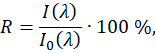
Here,  \A0\96 the intensity of the incident radiation, and
 \A0\96 the intensity of the reflected radiation.
Reflectance is 100 % if all the light energy striking the object is reflected
back to the imaging sensor. On the other hand, reflectance is 0 % if the entire
incident light is absorbed or transmitted by the object. Keeping in mind that
specific molecules interact with light in a unique way, in a specified range of
electromagnetic spectrum, the reflectance spectra of different materials on the
earth\92s surface such as soil (and its components), forest, water and minerals
will be different. The parts in which reflectance spectra are different are
regarded as spectral signatures or spectral markers. Remotely sensed images can
be classified using spectral markers, as each material present in has its own
unique spectral signature. The higher the spectral resolution of an imaging
sensor, the more information can be obtained in the collected spectra.
Hyperspectral sensors have higher spectral resolution than multispectral
sensors and thus the information gathered by HSI spectroscopy allows to
distinguish more subtle differences. Because of that, HSI is utilized by
geologists for mapping the land and water resources. It is also used to map
heavy metals and other hazardous wastes in historic and active mining areas.
The reflectance spectra of green vegetation, dry bare soil, and clean water are
compared graphically in Fig 3. It can be observed that the reflectance spectrum
for bare soil has fewer absorption bands (dips in the spectral contour) as
compared to that of green vegetation. This is resulting due to the factors
which affect the reflectance of soil (soil composition) vary in a narrow range
of electromagnetic spectrum. These factors include soil texture, presence of
minerals such as iron, surface roughness and moisture content in soil. Spectral
markers (absorption bands) of green vegetation are observed in the visible
range of the spectrum. This indicates the pigmentation in the tissues of the
plant of which chlorophyll is the primary photosynthetic pigment in green vegetation.
It is known that chlorophyll absorbs strongly in red (670 nm) and blue (450 nm)
regions which are called the chlorophyll absorption spectral bands. If a plant
is under stress the chlorophyll synthesis is reduced and the amount of
reflectance in the red (670 nm) region is shown to increase. The spectral
response of water has distinctive characteristics of absorption of light in the
near infrared region and beyond it. Common factors which affect the spectrum of
water are the suspended sediments and increased chlorophyll levels. In each
case the spectrum will change in accordance to the number of suspended
sediments or algae in water. The analysis of specific parts of the reflectance
spectra are the most sophisticated type of spectral data analysis which can
provide a detailed answer of the true nature of the spectral difference.
However, such requires a lot of expertise in the field of spectroscopy.\A0
\A0\96 the intensity of the reflected radiation.
Reflectance is 100 % if all the light energy striking the object is reflected
back to the imaging sensor. On the other hand, reflectance is 0 % if the entire
incident light is absorbed or transmitted by the object. Keeping in mind that
specific molecules interact with light in a unique way, in a specified range of
electromagnetic spectrum, the reflectance spectra of different materials on the
earth\92s surface such as soil (and its components), forest, water and minerals
will be different. The parts in which reflectance spectra are different are
regarded as spectral signatures or spectral markers. Remotely sensed images can
be classified using spectral markers, as each material present in has its own
unique spectral signature. The higher the spectral resolution of an imaging
sensor, the more information can be obtained in the collected spectra.
Hyperspectral sensors have higher spectral resolution than multispectral
sensors and thus the information gathered by HSI spectroscopy allows to
distinguish more subtle differences. Because of that, HSI is utilized by
geologists for mapping the land and water resources. It is also used to map
heavy metals and other hazardous wastes in historic and active mining areas.
The reflectance spectra of green vegetation, dry bare soil, and clean water are
compared graphically in Fig 3. It can be observed that the reflectance spectrum
for bare soil has fewer absorption bands (dips in the spectral contour) as
compared to that of green vegetation. This is resulting due to the factors
which affect the reflectance of soil (soil composition) vary in a narrow range
of electromagnetic spectrum. These factors include soil texture, presence of
minerals such as iron, surface roughness and moisture content in soil. Spectral
markers (absorption bands) of green vegetation are observed in the visible
range of the spectrum. This indicates the pigmentation in the tissues of the
plant of which chlorophyll is the primary photosynthetic pigment in green vegetation.
It is known that chlorophyll absorbs strongly in red (670 nm) and blue (450 nm)
regions which are called the chlorophyll absorption spectral bands. If a plant
is under stress the chlorophyll synthesis is reduced and the amount of
reflectance in the red (670 nm) region is shown to increase. The spectral
response of water has distinctive characteristics of absorption of light in the
near infrared region and beyond it. Common factors which affect the spectrum of
water are the suspended sediments and increased chlorophyll levels. In each
case the spectrum will change in accordance to the number of suspended
sediments or algae in water. The analysis of specific parts of the reflectance
spectra are the most sophisticated type of spectral data analysis which can
provide a detailed answer of the true nature of the spectral difference.
However, such requires a lot of expertise in the field of spectroscopy.\A0
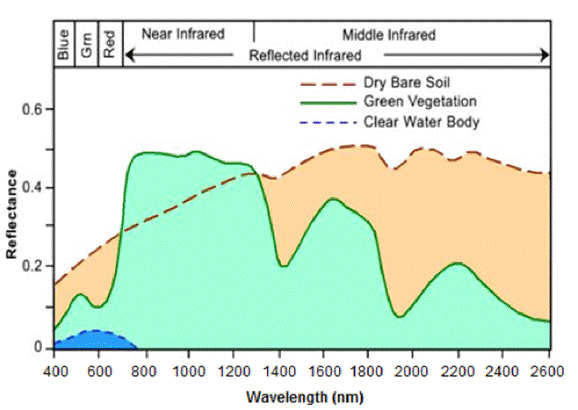
Fig. 3. Reflectance spectra of
different types of earth\92s surfaces (M. J. Khan, et al., 2018).
Less sophisticated and
more approachable analysis of the reflectance spectra in order to determine the
earth\92s surface composition and distinguish between the different types of
objects, can be performed using the so-called vegetation indices. These indices
are parameters evaluated by combining the values of reflection spectra taken
from different spectral bands. The vegetation indices are derived
experimentally and most often represent a certain type of classification
problem. For example, one of the most popular vegetation indices is the
Normalized difference vegetation index (NDVI) which is calculated by the
following equation:
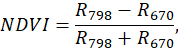
here the  \A0\96 reflection value at 798 nm and
  \A0\96 reflection value at 670 nm. This index can
be used to identify the green vegetation. Therefore, it is used to distinguish
between plants and soil, also it can be used to evaluate the condition of the
vegetation (healthy, sick, etc.). There are a lot more indices to choose from
which should be done carefully when tackling a specific problem.
\A0\96 reflection value at 670 nm. This index can
be used to identify the green vegetation. Therefore, it is used to distinguish
between plants and soil, also it can be used to evaluate the condition of the
vegetation (healthy, sick, etc.). There are a lot more indices to choose from
which should be done carefully when tackling a specific problem.
One more possible
approach of the spectral data can be done using mathematical algorithms or
chemometrics. This type of analysis most often ignores the spectral information
and analyses the spectral data as a whole. The finding of the differences or
the correlation of certain spectral features are thus given as a task to the
mathematical algorithms. These can range from the fairly simple clustering or
principal components algorithms to the much more advanced machine learning or
neural network methods.
\A0
Analysis of soil organic matter from hyperspectral or multispectral images
It is possible to evaluate the amount of soil organic carbon (and thus soil organic
matter) from the hyperspectral or multispectral images of the soil. It can be
done using one of all of the previously
mentioned analysis methods. By analyzing the raw spectral data, wavelength
regions having highest importance for SOC estimation can be identified. Many
studies were dedicated to finding these
spectral regions. One of the first researches
which observed how organic matter influences
the reflectance spectra of soil showed that different spectral features of
different levels of organic matter oxidation can be observed (S. A. Bowers, et
al., 1965). Other
research showed that OH groups have strong absorption features at the regions
of 1400\961900 nm, mainly due to soil water content, hydroxyls and clay content
(E. Ben-Dor, et al., 1995). It was also observed that
the reflectance spectrum of soil at specific
wavelengths could be correlated with organic components like cellulose, lignin
or starch (E. Ben-Dor, et al., 1997). It was found
that the visible region of the electromagnetic spectrum could also provide valuable
information for SOC estimation, considering that soil appears darker if SOC
content in the soil is higher (M. Ladoni, et al.,
2010). The spectral regions which are used most often in various studies are
highlighted in Fig. 4.
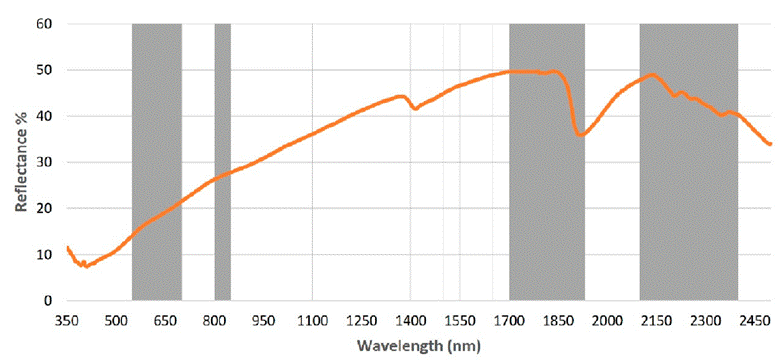
Fig. 4. Most prominent
spectral regions for SOC estimation from VIS-NIR reflection spectrum (T. Angelopoulou, et al., 2019).
One of the
key moments for accurate evaluation of SOC is the distinction between soil and
vegetation in the spectral data. Various vegetation indices could be of use for
this purpose. For example, one recent study on the possibilities of using
spectral images for soil analysis (Castaldi et al.,
2019) also performed the evaluation of SOC. The article focuses on issues of
accuracy and reliability, however, a couple of equations which allow the
calculation of the SOC from the spectral images by using indices is provided.
The described procedure is combined from several tasks. In order to create a
SOC map such procedures should be performed:
- NDVI
index is calculated from the reflection spectra. The NDVI is used to
identify the pixels which represent vegetation. All values
of the resulting NDVI layer which are higher than 0.35 are
removed. These values on the ground surface show a vegetation cover that is not
needed when assessing soil properties.
- Green
vegetation indices (GVI1 and GVI2) are calculated. These indices can be
evaluated by the following relations:


Pixels which have negative values of such indices
are also removed from the image. Such procedure improves the discrimination
between the soil and vegetation.
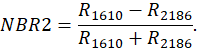
- Normalized
Burn Ratio 2 (NBR2) is calculated. Normally this index is used to evaluate
the burnt-out land, however, in this case it was used to distinguish
between the soil with high levels of moisture. The NBR2 is calculated as
follows:
The pixels representing heavily irrigated soil 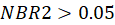 \A0are removed and only dry soil is being
analyzed. If the analysis does not require a high level of precision,
the NBR2 threshold can be increased to 0.075 or even 0.1.
\A0are removed and only dry soil is being
analyzed. If the analysis does not require a high level of precision,
the NBR2 threshold can be increased to 0.075 or even 0.1.
- After
the spectral images are cleaned (the pixels which are not suitable for
analysis are discarded) the SOC index is calculated in the remaining
images. The SOC is evaluated through the red edge carbon index (RECI).
This index is evaluated by the following relation:
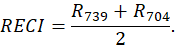
Using the calculated RECI values the amount of
SOC (expressed in g/kg) is calculated in the following manner:

- Using
the calculated values, a map of soil organic carbon is generated.
For the
accuracy analysis of the values obtained in the map are
correlated with data from laboratory tests on soil samples, taken from the same geographical coordinates. These points were used to verify accuracy and
errors of the method used. Finally, the organic carbon content is converted
into SOM by the already mentioned relation:

\A0
The SOM
content can be evaluated from the spectroscopic data not only by using
vegetation indices. In fact, on most occasions the concentration of SOM in the
topsoil is evaluated by creating mathematical models. Such models take into
account both the spectroscopic data and the available data on the real SOM
concentration which was evaluated using standard chemical analysis methods. The
mathematical models are useful because they can automatically find the
correlation between the spectral features and the true values of SOM.\A0 However, correlating the spectral features
with the properties of the soil requires the use of multivariate statistical
methods also known as chemometrics. The most common approach for such analysis
is the use of partial least squares regression (PLSR) method which describes
linear relationships between the variables. Yet it has been observed that
relationships are not always linear (X. Peng, et al., 2014). Because of that,
machine learning algorithms are increasingly used for the evaluation of
correlation processes.
The true values of SOC
can be estimated during field experiments or can be extracted from the
available databases. For example, on such a database LUCAS database is profoundly used in many publications.
LUCAS database is composed by collecting the
soil samples all across Europe and evaluating different parameters. The whole
procedure of the creation of the LUCAS
database is presented in Fig. 5.
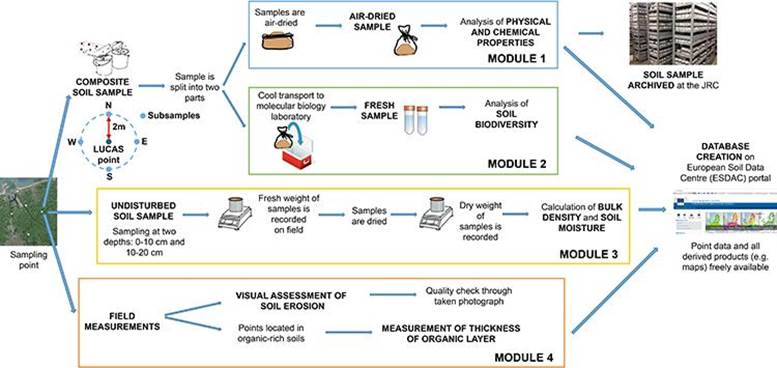
Fig. 5. LUCAS Soil
workflow from sampling to database generation (A. Orgiazzi,
et al., 2018).
The attempt to evaluate
the SOC in European soil using
the LUCAS database and NIR spectroscopy was published
by Antoine Stevens, et al., 2013. In this study the accuracy to predict SOC
content of different algorithms was tested to evaluate the potential of using
the LUCAS soil database and to cover soil heterogeneity. Several performance
parameters were analyzed and the best spectroscopic models having the highest
parameter scores were chosen. These were then tested again by using a separate
test set. It was observed that the accuracy of the predictions of SOC highly
depended on soil classes (cropland, grassland, woodland mineral, and organic)
and the use of auxiliary predictors (sand and clay). The results of the tests \96
performance parameter values, are shown in Table
3.
Table 3. Performance of the best spectroscopic
models as measured against the test set (Antoine Stevens, et al., 2013).
|
Subset |
Treatmenta |
MVCb |
Predictorc |
SDd |
RMSEPe |
Biasf |
SEP-bg |
RPDh |
R2 |
Ni |
|
Cropland |
SG1 |
svm |
spc |
8.6 |
4.9 |
0.2 |
4.9 |
1.74 |
0.67 |
2828 |
|
Cropland |
SG1+SNV |
svm |
rfe+clay |
8.6 |
4.0 |
0.1 |
4.0 |
2.17 |
0.79 |
2828 |
|
Grassland |
SG1 |
svm |
spc |
17.4 |
9.3 |
-0.9 |
9.3 |
1.86 |
0.71 |
1383 |
|
Grassland |
SG0 |
cubist |
rfe+sand |
17.4 |
6.4 |
0.1 |
6.4 |
2.7 |
0.87 |
1383 |
|
Woodland |
SG1 |
svm |
spc |
29.8 |
15.0 |
0.8 |
15.0 |
1.99 |
0.75 |
1564 |
|
Woodland |
SG0 |
cubist |
rfe+sand |
29.8 |
10.3 |
1.1 |
10.3 |
2.88 |
0.89 |
1564 |
|
Mineral |
SG1 |
svm |
spc |
19.1 |
8.9 |
0.2 |
8.9 |
2.13 |
0.78 |
6053 |
|
Mineral |
SG1 |
svm |
rfe+sand |
19.1 |
7.3 |
0.1 |
7.3 |
2.62 |
0.86 |
6053 |
|
Organic |
SG1+SNV |
cubist |
spc |
100.8 |
50.6 |
-10.9 |
49.5 |
1.99 |
0.76 |
368 |
aSpectral
transformation (SG0 = Savitzky-Golay smoothing; SG1 =
Savitzky-Golay first derivative; SNV = standard
normal variate);
bMultivariate
Calibration Model (svm = support vector machine
regression; cubist = Cubist);
cPredictor
used in the models (spc = spectral matrix; rfe = spectral matrix with bands selected by recursive
feature elimination);
dStandard
Deviation of the observations (g\B7kg-1);
eRoot Mean
Square Error of Prediction (g\B7kg-1);
fBias (g\B7kg-1);
gStandard
Error of Prediction (g\B7kg-1);
hRatio of
Performance to Deviation;
iNumber of
validation samples.
As the
authors of the study state all the models have shown limited accuracy in
predicting the values of SOC. This suggests that accurate SOC predictions based on
large scale spectral libraries can be hard to achieve. Prediction errors were
found to be related to SOC variation, SOC distribution (skewness) and variation
in other soil properties such as sand and clay content. The authors state that
VIS-NIR spectral data alone may not be able to contain enough information to
get accurate predictions of soil properties at large scales. Therefore, other
strategies that can address this issue, such as the use of additional
predictors in the modeling should be taken. However, other studies have gotten
better results. For example, algorithm of partial least squares regression
(PLSR) was applied together with the LUCAS database and remote Airborne Prism
Experiment (APEX) spectral data in order to create a model for SOC estimation
in the croplands of Luxembourg and Belgium (Fabio Castaldi,
et al., 2018). In this study a so-called bottom-up analysis approach was taken.
According to the authors,
such an approach avoids the main errors which arise because large spectral libraries are built
collating local libraries that were collected under differing conditions and
using different protocols and instruments. This approach predicts the SOC
values at sampling points based on the LUCAS spectral library. Then these
values were linked to the airborne spectra building a PLSR model. Finally, the
PLSR model was applied to all bare soil pixels of the airborne image producing
SOC maps with the same spatial resolution as the airborne data. Thus, this
approach allows laboratory analysis of the target variable to be avoided. The
accuracy of the proposed method was compared with the traditional approach -
the calibration of a multivariate model which links remote spectra and the
quantity of the SOC measured in the laboratory. The flowchart of the proposed
analysis method is presented in Fig. 6.
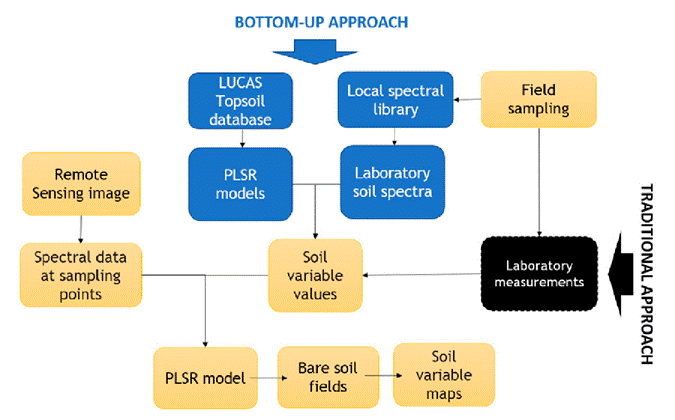
Fig. 6. The bottom-up
approach proposed by Fabio Castaldi et al., 2018.
The main difference
between the traditional and bottom-up approaches is that the latter does not
require analytical laboratory measurements. Instead, different soil variables
are estimated exploiting laboratory spectral data. The bottom-up approach
consists of two main steps:
- The
estimation of a soil variable at sampling points exploiting the LUCAS
spectral library and its ancillary data.
- The
mapping of the soil variables using remote-sensing data.
Artificial neural
networks were employed for the creation of the mathematical models for SOC
evaluation. NDVI was calculated in order to distinguish between the
hyperspectral imaging pixels representing vegetation and soil. The results of
this research have shown that the proposed bottom-up approach can provide the
results of SOC analysis in comparison to the standard approach involving the testing of the soil samples in the laboratory and correlating the results with the
data from the remote hyperspectral imaging.
A rather
complex and large study was performed in order to analyze the differences in
the spectral data provided by hyperspectral and multispectral imaging
satellites and to estimate the best approach for SOC evaluation
(D. \8Ei\9Eala, et al., 2019). The study was conducted in
the Chernozem region of Czechia. Field sampling and predictive modeling of the
spectral data was performed. The spectral data was collected from multispectral
Sentinel-2, Landsat-8, and PlanetScope satellites,
and multispectral Parrot Sequoia UAV. Aerial hyperspectral CASI 1500 and SASI
600 data was used as a reference. The data processing steps were as follows:
- Pixels
in individual data sources were filtered based on NDVI value. The
threshold was set to 0.25.
- The
filtered dataset was partitioned into a training set and a test set.
- A
mathematical model was trained using the training set. Several models were
tested and the final model was selected based on the smallest value of
root mean square error of cross-validation.
- The
accuracy of prediction was evaluated by determining the measure of
accuracy computed based on a comparison of observed and predicted values of
the validation set.
- Finally,
the best model was applied to the entire dataset of image spectral data.
The results
of the study have shown that very similar prediction accuracy for all
spaceborne sensors with only minor prediction variance can be obtained. The
results of the SOC mapping with the data from different imaging systems are
presented in Fig. 7.\A0\A0\A0\A0\A0\A0\A0\A0
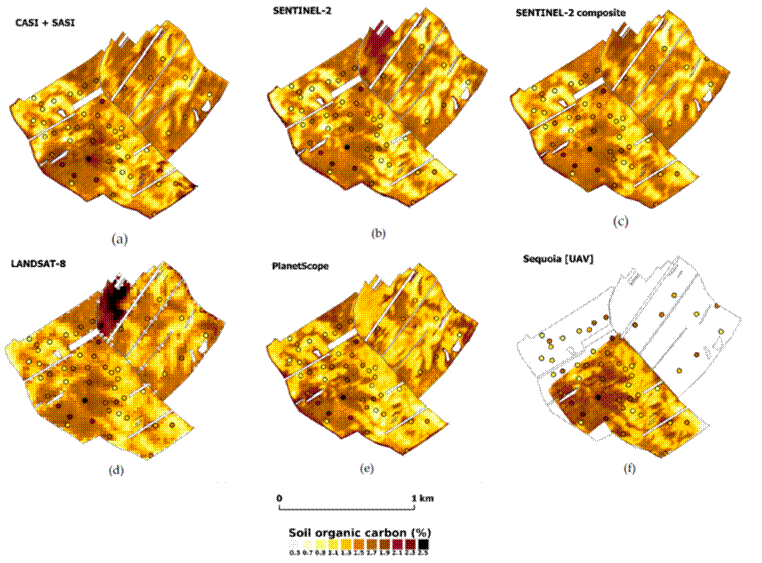
Fig. 7. SOC maps
calculated using different remote sensing platforms (D. \8Ei\9Eala,
et al., 2019).
Several other studies
have tested the efficiency of the mathematical algorithms for soil analysis and
organic carbon concentration evaluation. A study done in Greece (P. Tziachris, et al., 2019), have compared several machine
learning algorithms and found that the result of the SOC evaluation is
dependent on the algorithm choice. It was determined that algorithms such as
Random Forest or Gradient Boosting show better accuracy than other methods like
Ordinary Kriging. A review on the different algorithms used for determination
of SOC content (S. Lamichhane, et al., 2019) has also
evaluated that machine learning algorithms provide more accurate results. This
study has also looked into the environmental covariates which are most
important for one of the machine learning algorithms (Random Forest).
Covariates representing organism activities were the most frequent among the
covariates, followed by the variables representing climate and topography.
Climate was reported to be influential in determining the variation in SOC
level at regional scales, followed by parent materials, topography and land
use. However, for mapping at a resolution that represents smaller areas such as
a farm- or plot-scale, land use and vegetation indices were stated to be more
influential in predicting SOC. Similar conclusions were drawn in another
study written by T. Angelopoulou, et al., 2020. The
authors find that the results of spectral SOC estimations are promising but
more research needs to be done in terms of selecting the spectral range,
preprocessing methods, and the calibration techniques. Also, as already
mentioned a specific importance should be kept on covariates such as soil
moisture, soil roughness, vegetation cover, and others that affect SOC spectral
response. Authors stated that various inconsistencies among studies should be
solved. Therefore, when publishing results more information should be included
about the experimental design, the criteria used for the selection of the
chemometric approach, and the pre- and post- processing procedures in order to
facilitate comparisons of results among studies.
A lot of effort is being
put in order to create the best tool for SOM evaluation from the spectroscopic
data. However, there is no census on what approach is the best as we can see
from the various publications and performed studies. Still a lot can be learned
to take the best approach possible at this time. What has to be taken into
account first is that spectral regions which can be used to quantify soil
organic carbon (SOC) are located mainly in broader bands in the visible region
of the spectrum and in the narrower bands of the SWIR spectrum (between 1600
and 1900 nm and around 2100 and 2300 nm). Because of that, the spectral
resolution of the sensors significantly influences the quality of SOC
predictions. Because of that it is necessary to use data with appropriate
spectral resolution taken across the VNIR-SWIR spectrum for accurate SOC
estimates. Second, a
well thought out method for processing the data
should be used. Usually, different thresholds of vegetation indices are used
for identifying and removing unwanted pixels in the image. Mainly NDVI for
green vegetation, NBR2, or MID-infrared for non-photosynthetic vegetation or
combined indexes, such as Bare soil index (BSI) or PV are used. Also,
statistical parameters \97 mean, median, or minimum or other methods used that
improve the image values are used. These for example, can be application of PCA
components, calculation of standard deviation or using low-pass filter.
Furthermore, it is necessary to develop new algorithms, not only for
identifying bare soils, but also for removing the influence of moisture,
surface roughness, or vegetation residues. Clouds and unwanted shades also affect the input data and should also be taken into account.
Lastly, the lack of comparability between different studies is a big issue.
Model evaluation and accuracy is investigated using different methods. Thus,
different studies are deprived of certain information which is essential for
the comparison between the results. What is more, different laboratories used
different protocols for soil sampling and measurements together with different
instrumentation. These factor in and hinder the reliability of the results. To
tackle this challenge a unified soil spectral library (SSL) potentially could
be a strong boost towards a more accurate prediction of SOM.